adem
d'ethnomusicologie
North Indian musical tradition
Nicolas Delaigue
Asia | Instruments & repertories
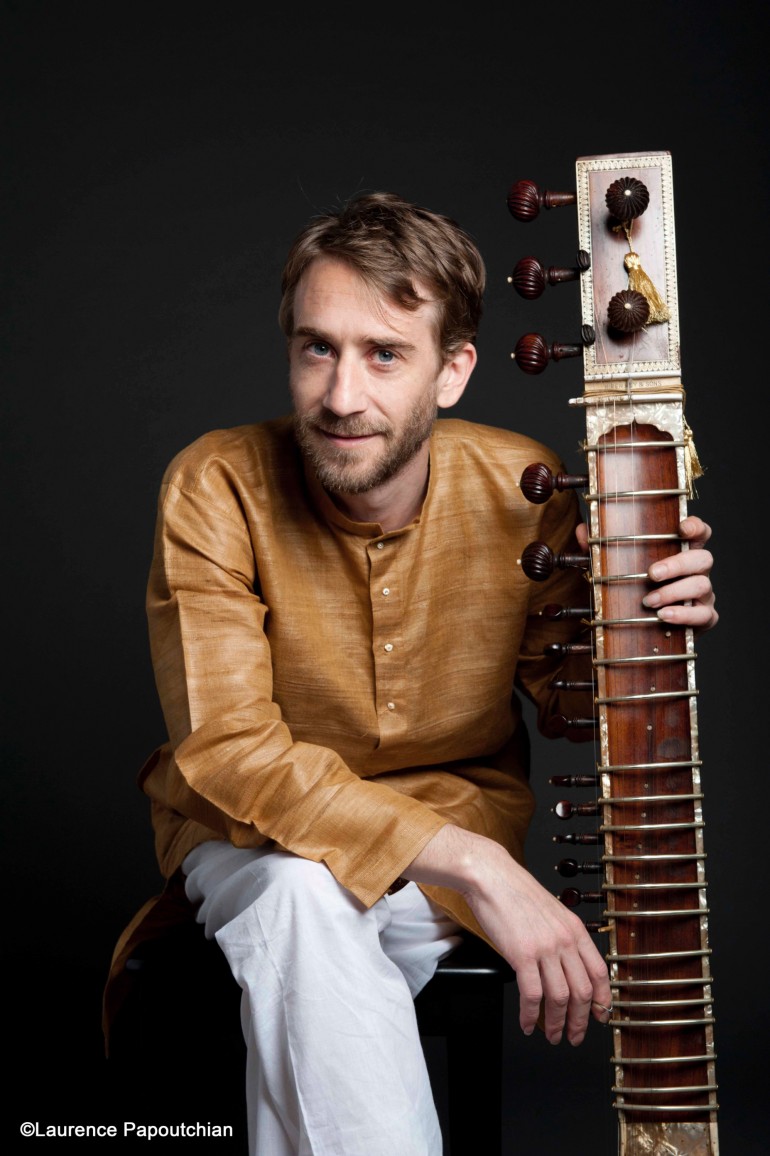
These courses propose a discovery and learning of the repertoire and musical forms of Hindustani music, which will interest all musicians and composers whatever their aesthetic and instrument: learning of melodic and rhythmic forms (râga - melody - and tâla-s - metric), and of their development (elaboration structure, modal improvisation) The transmission of this traditional art is done orally and is accompanied by a contextualization of its cultural, theoretical and aesthetic elements.
The courses also offer the learning of traditional sitar techniques and repertoire. For those who do not have an instrument, sitars can be lent to students.
Sessions are open to both beginners and advanced musicians. Individual lessons and group workshops are available upon request.
Bio
Nicolas Delaigue is a sitar and surbahar player, specializing in North Indian music. Through his atypical career, and after years of immersion, practice and dedication to this art, he has created a bridge between India and the West, and has become an essential reference in the interpretation and teaching of this music in Europe. Residing in Lyon, he is an international concert performer. Nicolas Delaigue has been trained for many years on the sitar by great masters such as Patrick Moutal, Indrajit Banerjee, Sugato Nag and Ustad Shahid Parvez.
Nicolas has been teaching sitar, Indian music and modal improvisation for fifteen years in public, private and associative structures throughout France and Europe, and he is regularly invited in various cultural, university and educational centers for conferences and demonstrations, He is regularly invited to various cultural, university and educational centers for lectures, demonstrations, workshops, student supervision, and competition juries (Cité de la musique de Paris, CNSMD de Paris, CRR de la Réunion, Ljubljana University, Université Jean Monnet de Saint-Etienne, CRR du Grand Chalon, CRR de Boulogne-Billancourt, CRR de Saint-Étienne, CRD de Macon, CRD de Bourgoin Jallieu. ..). Holder of the State Diploma of Traditional Music, Nicolas has a deep experience of musical pedagogy and he teaches all year long to many students in private and group lessons.
PLACE : Ateliers d'ethnomusicologie - 10, rue Montbrillant - 1201 Genève
TIMETABLE : Tuesday from 14h00 to 18h00, 2h group lesson and 1h individual lessons
DATES 2023 : 12 et 26 septembre; 10 et 24 octobre; 7 et 21 novembre; 5 et 19 décembre
DATES 2024 : 9 et 23 janvier; 6 et 20 fevrier; 12 et 26 mars; 3 et 16 avril; 7 et 21 mai; 4 et 18 juin
FEES : contact Nicolas Delaigue at nico_delaigue@yahoo.fr
CONTACT :
T : +33 (0)6 76 28 35 87
Email: nico_delaigue@yahoo.fr
Discover other classes
Argentine tango and folk music
Possibility of lessons by video conference, individual or group lessons. Infos : pedroratto@hotmail.com
Pedro Ratto
Differents courses with the aim to learn on guitar tango and the different rhythms of Argentine music.
Afro-fusion dances - adults
NEW COURSE FOR ADULTES
Dominique Rey
This class will explore the language of contemporary African dance, its energy and rhythms.
Carnatic vocals
Lakshmy Natarajan
Carnatic music is considered one of the most ancient music systems in the world. It is a learned music that is full of emotion and involves a lot of improvisation.
Iranian luths : Tar and setar
Sogol Mirzaei
This class offers training in traditional Persian music through introductory or advanced practice of two of its principal instruments: the târ and setâr lutes.
